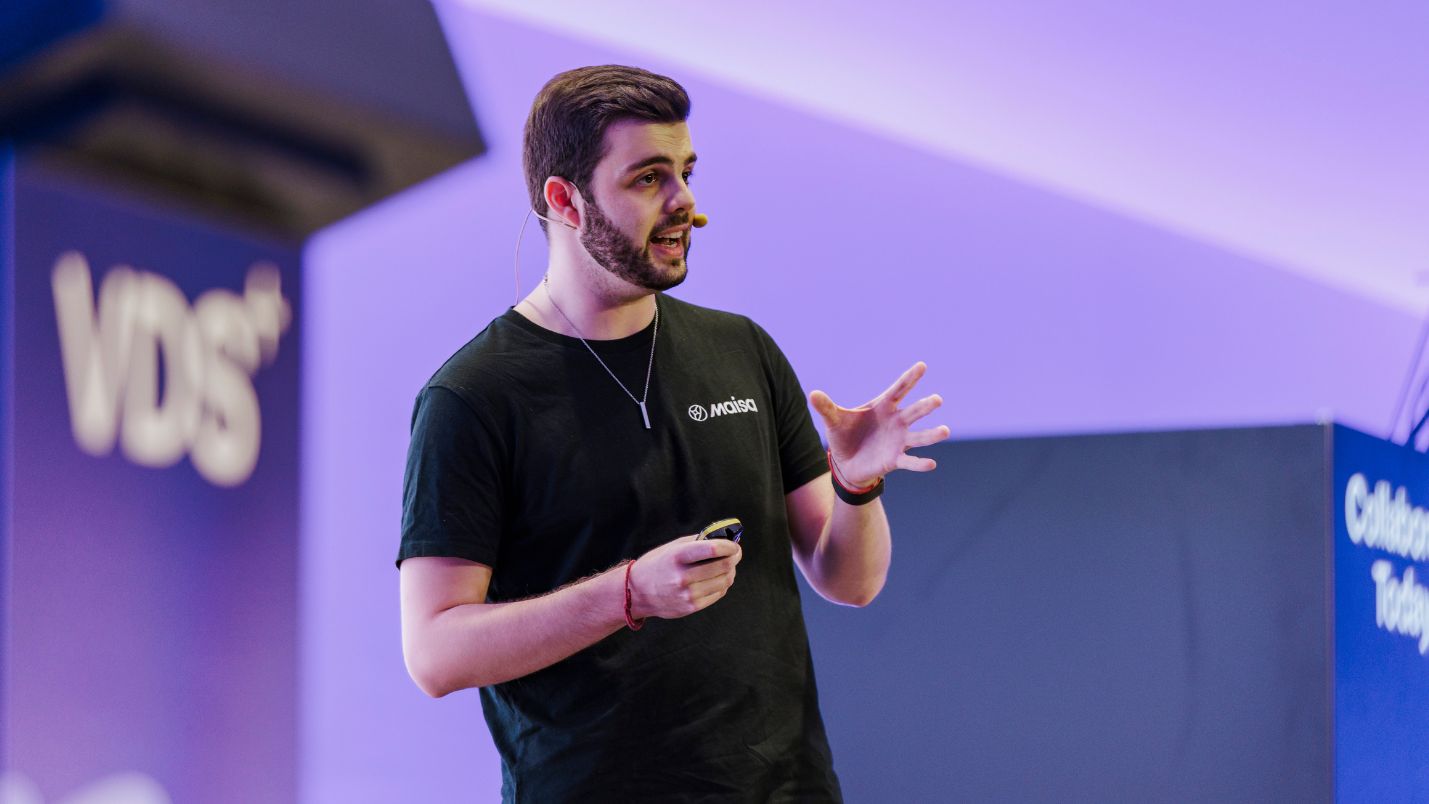
The last edition of VDS was not only a showcase of emerging technologies. It was also a space to examine AI with a more critical and strategic lens, especially the part most enterprises underestimate: taking AI from promising pilots to reliable, measurable impact in production.
In that context, David Villalón, Co-founder and CEO of Maisa AI, broke down what it truly takes to scale AI in highly regulated environments such as banking, energy, and infrastructure, where errors are not just costly, they are often unacceptable.
Villalón‘s message was blunt. He argued that 95% of enterprise AI projects fail when they try to scale into production, and that even among the minority that do ship, only a smaller fraction creates tangible value. His point is increasingly echoed across the market as organizations move from experimentation to execution.
The 3 barriers that break enterprise AI at scale
Villalón identified three recurring failure points that consistently appear when teams try to move beyond demos.
First, hallucinations and contextual errors undermine trust in environments where outputs must be auditable and defensible. Second, lack of process fidelity destroys ROI. If a human must permanently validate every step, the system may look automated on paper, but it cannot operate end to end in practice. Third, fragmented infrastructure inside large organizations makes reliable deployment difficult, particularly in multinationals running different technology stacks across countries while meeting strict security and compliance constraints.
This is the moment many enterprises discover the gap between AI that performs in a controlled pilot and AI that survives production reality.
The hidden bottleneck: the human latency tax
One of the most useful concepts Villalón introduced was what he called the human latency tax.
Organizations often assume that when a task is assigned to a person, it will happen immediately. In practice, work moves through queues, priorities, reviews, escalations, and internal friction. Even when the AI is fast, delivery slows down because the human becomes the central orchestration layer. The system can only move as quickly as the organization’s human bandwidth allows.
This is not a critique of people. It is a structural diagnosis. If humans remain the default coordination node for every process, enterprises struggle to compete on speed, reliability, and scalability.
Maisa AI’s thesis: Digital Workers designed for production
Maisa AI‘s proposal is to build Digital Workers capable of executing processes end to end, combining manual and cognitive steps without relying on a human as the central node. The emphasis is not “more AI”, but more controllable AI, built for production constraints: traceability, permissioning, risk control, and operational resilience.
This production-first positioning is reinforced by the company’s recent momentum. In August 2025, Maisa AI announced a $25 million seed round led by Creandum and Forgepoint Capital, with participation from NFX and Village Global, alongside the launch of Maisa Studio, a platform aimed at deploying Digital Workers at enterprise scale.
Earlier, the company reported a $5 million pre-seed round led by NFX, joined by Village Global, supporting its mission around accountable AI.
This context matters because it signals what the market is rewarding right now: not more prototypes, but systems engineered for production, governance, and measurable outcomes.
Scaling from one agent to thousands is not only a technical problem
A key takeaway from Villalón‘s session was that the next wave of enterprise AI will be defined by operational maturity, not model novelty.
When an organization gets one Digital Worker to succeed, it immediately wants to replicate it across hundreds or thousands of workflows. At that point, the challenge expands beyond models into access and permissions, risk control, regulatory compliance, data localization and sovereignty, cybersecurity, observability, and resilience under failure. The real bottleneck becomes an organization’s ability to operate AI reliably at scale, not just to build it.
Villalón‘s closing message was optimistic. He argued there is a rare window of opportunity for startups and technology companies that design AI for production from day one, especially in regulated industries where reliability is not a feature, it is the product.
To explore more sessions and insights like this, browse the official VDS content hub at VDS News.
Martin Gomez
Related posts
Become a sponsor or exhibitor
Connect with the global tech ecosystem, increase your visibility, and generate high-value leads through curated meetings with partners, clients and decision-makers.
Become a sponsor or exhibitor
Connect with the international tech ecosystem, increase your visibility and grow your business by meeting new partners, clients and hundreds of potential prospects.